
Analyzing options contracts requires detailed understanding of multiple data points and metrics simultaneously, options do not behave like stocks or bonds and their value depends on multiple variables such as price, time, volatility or rates simultaneously.
Whether you are evaluating a single contract or screening hundreds of opportunities, systematic analysis separates profitable organization and users from costly mistakes.
Effective options analysis rests on three core pillars: understanding the underlying asset, evaluating contract-specific metrics such as implied volatility, Greeks, series data, open interest, and deliverables, and assessing broader market and portfolio conditions. This guide outlines the essential components of options data analysis, explains how to interpret critical metrics, and shows how high-quality data feeds, like those provided by Symbol Master, enable more accurate, scalable, and defensible decision-making.
Understanding the Foundation: Essential Options Data
Before any analysis on specific contracts can begin, financial professionals need access to complete, accurate, and standardized options market data. Even the most sophisticated models or risk frameworks will produce misleading results. Whether you are assessing individual contracts or aggregating exposures across portfolios, the integrity of your inputs determines the quality of your outputs.

Core Data Requirements
Option analysis that is sturdy starts with a comprehensive dataset that captures the complete optionable equity universe in the market. This includes options series information, all available strikes, expiration date, and contract specifications, this allows analysts to properly map the opportunity set. End of Day (EOD) and Start of Day (SOD) Reference and Pricing data is equally important, including bid/ask spreads, last trade, volume, open interest corporate action, unadjusted and adjusted values.
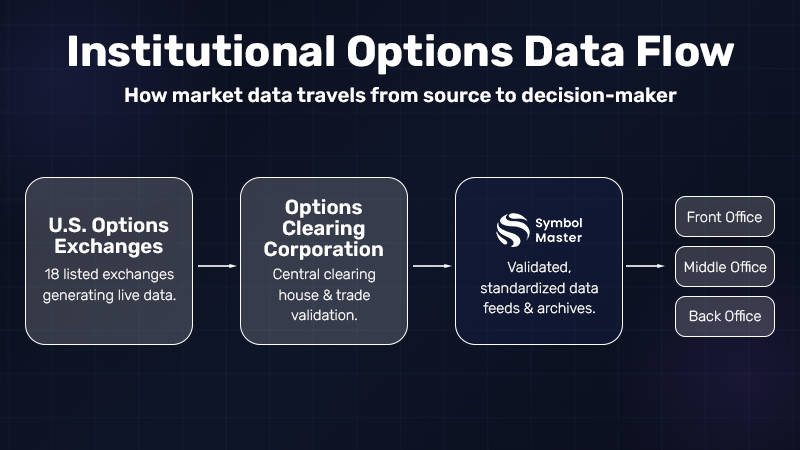
Every listed strike level, open interest across all tradable options on 18 exchanges (cleared through the Options Clearing Corporation) provides visibility into positioning and liquidity. Historical archives of all files ensure data integrity, back testing strategies and pricing models, risk management, and pattern analysis. Without this comprehensiveness and harmony, incomplete or inaccurate data leads to flawed analysis, and poor data quality that ultimately impact all firm decisions.
The Role of Reliable Data Feeds
Professional users depend on validated and standardized data feeds to ensure consistency across front, middle, and back office workflows. This is where providers like Symbol Master play a critical role.
By maintaining comprehensive options series coverage across all exchanges, Symbol Master ensures complete visibility into the tradable universe. Its extensive historical archives, support rigorous backtesting, model validation, and pattern recognition across market cycles.
For a deeper look at coverage and capabilities, explore the Symbol Master service offering, which highlights options series master data and full market data coverage essential for institutional-grade options analysis.
Analyzing Contract-Specific Metrics
Once a solid data foundation is in place, the next step in options analysis is evaluating the contract-specific metrics that define each option’s behavior. These metrics capture how a contract responds to changes in price, time, volatility, and broader market conditions, making them essential for risk assessment, valuation, and portfolio construction.
Implied Volatility Analysis
Implied volatility is a forward-looking measure of market expectations and a primary input into option pricing. From our perspective, effective options data analysis requires comparing implied volatility with realized and historical measures to contextualize pricing across time and market regimes. This comparison helps determine whether options are relatively overvalued or undervalued.
Symbol Master delivers comprehensive coverage across implied, realized, and historical volatility datasets, enabling users to perform consistent cross-sectional and time-series analysis. This is particularly critical around earnings announcements and global macro events, where volatility expectations, and therefore option prices, can shift rapidly.
The Greeks: Measuring Risk and Sensitivity
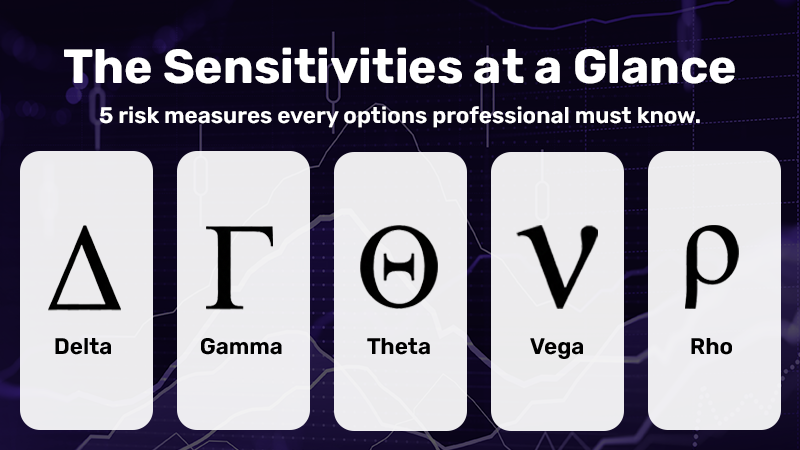
Implied Volatility and Greek Sensitivities form the backbone to accurate options analysis. Delta measures how an option’s price responds to a $1 move in the underlying asset, indicating directional exposure. Gamma tracks how quickly that exposure changes, making it essential for managing hedging adjustments. Theta captures time decay, quantifying the daily erosion in option value, while Vega reflects sensitivity to volatility, often the dominant risk factor during earnings cycles or market stress. Rho, though typically less impactful for short-dated contracts, measures sensitivity to interest rate changes.
At Symbol Master, we process and validate implied volatility and Greeks through a curated mathematical pipeline designed for precision and consistency. These analytics empower front, middle, and back office users to perform accurate risk assessment and portfolio position sizing, supported by data that meets institutional standards.
Historical Indicators
Historical EOD and SOD datasets provide the context needed to interpret current market conditions. At Symbol Master, we emphasize the importance of long-term, high-quality historical archives to uncover patterns in pricing, liquidity, and volatility behavior.
Key indicators such as volume and open interest offer insight into market participation and liquidity. Higher levels typically signal more efficient price discovery and more reliable execution conditions. By delivering clean, standardized historical data, we enable professionals to identify trends, validate models, and make more informed decisions across the full lifecycle of options analysis.
Evaluating Market Context
At Symbol Master, we emphasize that options cannot be analyzed in isolation. Broader market conditions, price trends, sentiment, and volatility structure, directly influence how contracts are priced and how risk evolves. Incorporating market context into your workflow ensures that contract-level analysis is grounded in real-world conditions rather than abstract assumptions.
Analysis of the Underlying and Optionable Asset
A disciplined approach begins with the underlying asset. Identifying trend direction using tools such as moving averages, as well as key support and resistance levels, provides the directional framework for analysis. Options positioning should align with this bias—calls in bullish conditions, puts in bearish environments, and spreads when markets are neutral or range-bound.
Beyond direction, detailed data attributes, including strike availability, expiration cycles, and contract specifications, play a critical role in selecting appropriate strike prices. Accurate series data ensures that professionals can map exposures precisely and avoid misalignment between strategy and market conditions.
Market Sentiment Indicators
Market sentiment adds another layer of insight. Put/Call ratios help gauge overall positioning and can indicate whether markets are skewed toward bullish or bearish expectations. Unusual options activity, such as large or atypical trades, may signal informed positioning or institutional flows.
Equally important is understanding the volatility surface and term structure, which reveal how implied volatility varies across strikes and maturities. These dynamics provide critical insight into pricing inefficiencies and sentiment shifts, influencing both valuation and risk assessment across the entire options landscape.
Building Your Analysis Workflow
A consistent, data-driven workflow is essential for scalable and defensible options data analysis. At Symbol Master, we advocate for a structured approach built on high-quality, validated data inputs to ensure analytical integrity across all stages of evaluation.
Step-by-Step Analysis Framework
- Define your market outlook and time horizon for the underlying asset
- Screen for relevant contracts based on expiration cycles and strike criteria
- Evaluate realized, historical, and implied volatility, both empirical and theoretical, alongside Greek sensitivities to quantify risk exposure
- Compare volatility measures relative to current levels to assess pricing context
- Review historical metrics, including SOD/EOD data, valuations, volume, and open interest, to validate liquidity and behavioral patterns
Tools and Data Requirements
Effective options analytics depend on precise, comprehensive, and curated data. Symbol Master provides the foundational datasets required for institutional workflows, including complete series information, realized, historical, and implied volatility along with Greek sensitivity measures, and term structure with expiration schedules.
Our validated data feeds integrate seamlessly into a firm’s security master and enterprise platforms, enabling consistent data quality across internal risk, analytics, and trading systems. For a detailed view of data breadth and delivery options, including SFTP and API access,
contact Symbol Master.
Conclusion
Successful options analysis workflows depend on combining high-quality data with a structured analytical framework. From understanding contract-specific metrics, such as series data, implied volatility, Greek Sensitivities, and liquidity; to evaluating broader market context and applying systematic processes, each component plays a critical role in informed decision-making.
Reliable data is the foundation of this process. Symbol Master’s comprehensive options data offerings and historical archives, provide our consumers with accurate and consistent building blocks that financial professionals require.
Ready to access unified institutional-quality options data for your analysis?
Explore Symbol Master and discover how our data can power your workflow.
For the short version, read the nine benefits of choosing Symbol Master.


George Tull is the CEO and President of Symbol Master Inc., a New Jersey-based financial data company that has been a trusted source of options symbology, market data validation, and data quality services since 2003. With a background spanning institutional data services, including six years leading Pre & Post Sales across North America at ICE Data Services, George brings hands-on experience from both the sell side and the data infrastructure layer that powers modern options trading.
At Symbol Master, George oversees the validation of core options exchange content and arbitrates data across multi-listed options symbols in the National Market System, ensuring that the order flow platforms, analytics firms, and trading desks that depend on this data can trust what they’re working with. He led the development and launch of Worldwide Greeks, a transparency-first derivatives analytics product built in collaboration with Exchange Data International.